Best Index Funds 2026: 5 Compared on Cost and Coverage
Expense ratios have converged so close to zero that picking the wrong index fund now costs you almost nothing — and yet the differences in tax efficiency, portability, and trading mechanics still matter over decades. These five funds cover nearly the same market but serve different investors in meaningfully different ways. Here is what separates them after you strip away the marketing.
Quick answer
For most taxable accounts, VTI is the pick — 3,700+ US stocks at a 0.03% expense ratio, and the ETF structure lets Vanguard flush unrealized gains for better tax efficiency than a mutual fund. Fidelity's FZROX is the cheapest fund in existence at 0.00% but tracks a proprietary index and is not portable, SWTSX allows dollar-based automatic investing at Schwab, and SCHB is Schwab's tight-spread ETF answer to VTI.
Funds evaluated on five criteria: expense ratio, fund size and liquidity, tax efficiency (ETF structure vs mutual fund), brokerage portability, and historical tracking error vs the target index.

Vanguard Total Stock Market ETF (VTI)
Best Overall: VTI holds 3,700+ US stocks at 0.03% ER and is the default recommendation for taxable brokerage accounts. Its ETF structure means Vanguard can flush unrealized gains in-kind, and the fund has issued zero capital gains distributions since 2000.
Top picks ↓| Product | Price | Link |
|---|---|---|
| $0.03〜0.03Reference price | ||
| $0〜0Reference price |
Related articles


Available at Vanguard, Fidelity, Schwab, and most brokerages. No minimum at most brokers.
VTI holds 3,700+ US stocks at 0.03% ER and is the default recommendation for taxable brokerage accounts. Its ETF structure means Vanguard can flush unrealized gains in-kind, and the fund has issued zero capital gains distributions since 2000. Works at any brokerage, trades with spreads under $0.02.
Pros
- ✓Zero capital gains distributions since 2000
- ✓Holds at any brokerage — fully portable
- ✓Ultra-tight bid-ask spread, $400M+ daily volume
Cons
- ✗0.03% ER vs FZROX's 0.00% — tiny but nonzero
- ✗Must buy in whole shares unless brokerage supports fractional ETF trading
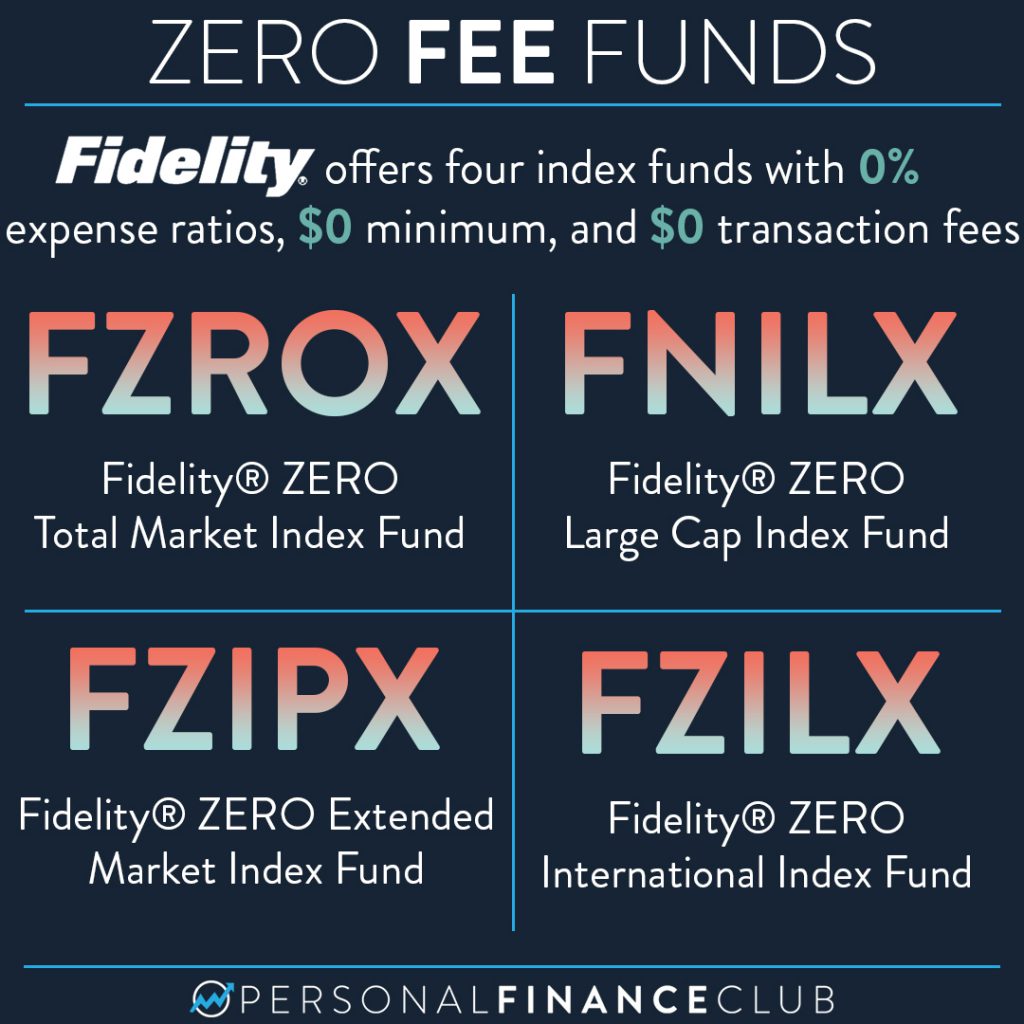
Available only at Fidelity. No minimum investment, no transaction fee.
FZROX is the cheapest index fund in existence at 0.00% — Fidelity absorbs all operating costs as a customer acquisition strategy. The fund tracks Fidelity's proprietary US Total Investable Market Index with near-zero tracking error since its 2018 launch. The only real downside is portability: you cannot transfer shares out of Fidelity without selling.
Pros
- ✓0.00% expense ratio — truly free to hold
- ✓Mutual fund structure allows automatic investing in exact dollar amounts
- ✓No minimum investment
Cons
- ✗Fidelity-only: selling required if you change brokerages
- ✗Proprietary index, not CRSP or Russell — minor methodology differences
What to look for in a total-market index fund
The fund landscape looks identical on the surface — near-zero fees, broad diversification, passive management. The differences live in structure, tax treatment, and where you can hold them.
How the five funds have performed
VTI, SWTSX, and SCHB have tracked the same CRSP US Total Market Index (or close equivalents) within a few basis points annually for over a decade. Their 10-year annualized returns through 2025 are within 0.05% of each other — effectively identical. FZROX has existed only since 2018 but has tracked its proprietary Fidelity US Total Investable Market Index with near-zero error.
SPY tracks the S&P 500, which has outperformed total market funds in 8 of the last 15 years due to large-cap dominance. Over full market cycles, the difference is negligible — the 2000s saw small-caps outperform significantly. Neither approach has a durable edge; your preference for simplicity or completeness matters more than picking the historically-superior index.
Bottom line
If you want the lowest possible cost and live inside Fidelity's ecosystem, FZROX's 0.00% ER is hard to argue against — just understand you cannot transfer the shares if you leave. VTI is the consensus choice for taxable accounts at any brokerage: ultra-low cost, maximum liquidity, and the ETF structure minimizes capital gains distributions. SCHB is the identical pick for Schwab users who prefer their native fund family.
SWTSX makes sense only inside a Schwab retirement account where portability is irrelevant. SPY belongs in options strategies, institutional portfolios, and short-term tactical trades — its 0.09% ER is a needless drag for long-term buy-and-hold investors who can buy VOO at 0.03% for the same S&P 500 exposure. Match the fund to your brokerage and your time horizon, then stop thinking about it.
Frequently asked questions
Is FZROX really free? What's the catch?▼
VTI vs SCHB — which is better for a Schwab user?▼
Why does SPY have a higher expense ratio than VOO?▼
Can I hold VTI in a Roth IRA?▼
Total market fund vs S&P 500 fund — which has better long-term returns?▼
Prices change. Check the retailer for the current price.
Comments & questions
Discussion happens on nattzy, our community forum. Sign in with Google to post — it takes a second.
Related articles
Best Budgeting App 2026: 5 apps after the Mint shutdown
Best Stock Trading App 2026: 5 Brokers Compared
Best Air Purifier 2026: 5 models compared honestly

ConoHa WING review (2026): setup, speed and pricing
Best JP rental server 2026: 5 hosts ranked

Best LED Face Masks 2026: 3 Light Therapy Devices Compared