Best Inflatable Kayak 2026: 5 Packable Kayaks Compared
Most disappointing inflatable kayaks are not leaky. They are soft: the hull flexes, the bow wanders with every stroke, and a short breeze turns a relaxed paddle into a steering exercise.
Quick answer
The Advanced Elements AdvancedFrame is the inflatable kayak to buy for most people: aluminum ribs in the bow and stern give it a real hull shape, so it tracks far straighter than a pure air-tube boat at a mid-range price. Buy the Sea Eagle RazorLite if you want to cover distance, the Aquaglide Chelan for a stiff drop-stitch boat that is easy to live with, the Intex Excursion Pro if budget is the limit, and the Sevylor QuikPak K1 if the kayak has to fit in a car boot with everything else.
We did not paddle, inflate or pressure-test any of these kayaks ourselves. A fair test would need the same water, the same paddler and a GPS-logged course in controlled wind for every boat, which we do not have. What we did instead: collected the published specifications (length, width, weight, rated capacity, recommended pressure, construction) from each manufacturer's product pages and manuals, checked current pricing across major US retailers, and read owner reviews in volume, weighting repeated complaints — slow leaks at valves, poor tracking, seats that collapse, pumps that give up — over first-outing impressions. Capacity, pressure and weight figures are manufacturer claims unless we say otherwise.

🏆 Best overall: The AdvancedFrame is the pick because it solves the core inflatable problem — a soft, wandering hull — with aluminum ribs in the bow and stern that give it a defined shape and a proper waterline. The result paddles closer to a hard-shell recreational kayak than anything else at this price.
Top picks ↓| Product | Price | Link |
|---|---|---|
| $550〜$800Reference price | ||
| $1,000〜$1,400Reference price | ||
| $800〜$1,300Reference price | ||
| $150〜$260Reference price | ||
| $150〜$230Reference price |
Top picks
Related articles
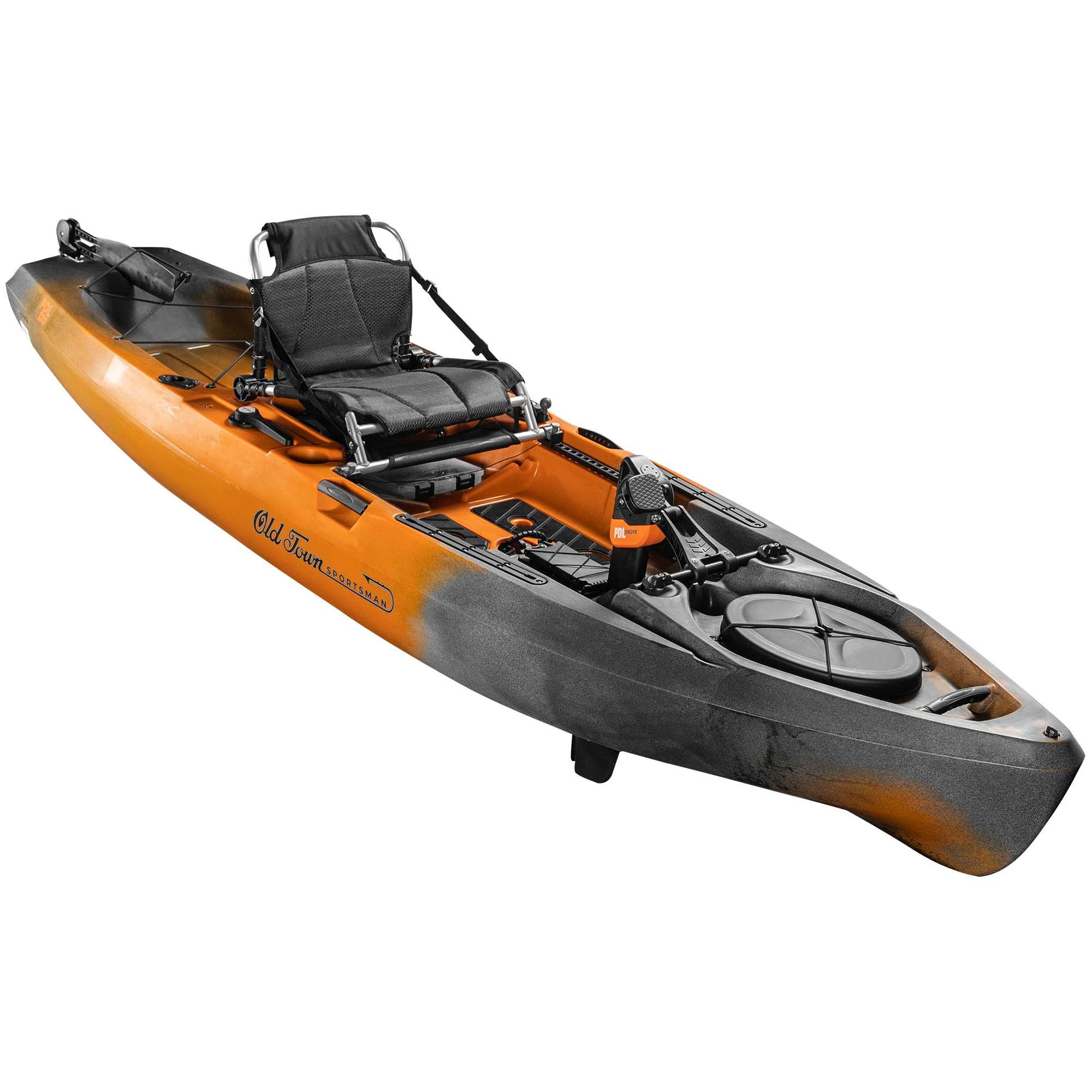


Several AdvancedFrame variants exist (standard, Convertible, Sport, Expedition) — confirm the model name matches the one you want.
The AdvancedFrame is the pick because it solves the core inflatable problem — a soft, wandering hull — with aluminum ribs in the bow and stern that give it a defined shape and a proper waterline. The result paddles closer to a hard-shell recreational kayak than anything else at this price. It is heavier and slower to set up than a pure air boat, and the seat is its weakest component, but for lakes, slow rivers and sheltered coast it is the most complete all-rounder here.
Pros
- ✓Rib frame gives straight, predictable tracking
- ✓Durable multi-layer construction
- ✓Handles wind better than tube-only boats
Cons
- ✗Heavier and bulkier packed than basic inflatables
- ✗Stock seat lacks support on long days

Sold in solo and tandem packages; the package, not the hull, sets the price difference.
The RazorLite is built almost entirely from high-pressure drop-stitch panels, which makes it the stiffest and fastest boat in this comparison. Its long, narrow hull glides and holds a line in a way no budget inflatable can. The trade is stability and price: it feels tippier than wider recreational boats at first, and it costs several times more than the Intex. For paddlers who already know they want to go far, it is the one to buy.
Pros
- ✓Very stiff drop-stitch hull
- ✓Fastest and best-tracking boat here
- ✓Long enough for real day touring
Cons
- ✗Less initial stability than wide recreational boats
- ✗Premium price

The Chelan comes in several lengths under the same name; match the number in the model to the seating you need.
The Chelan uses drop-stitch sidewalls and floor to create a stiff, flat hull that feels planted rather than twitchy. It sits between the AdvancedFrame and the RazorLite: more stable and easier to get in and out of than the RazorLite, stiffer than a tube boat. It comes in single and tandem lengths, so check which one you are buying. It suits paddlers who want rigidity without committing to a narrow touring shape.
Pros
- ✓Stiff, flat drop-stitch hull
- ✓Stable and easy to board
- ✓Available in solo and tandem lengths
Cons
- ✗Not as fast as the RazorLite
- ✗Several lengths under one name cause listing confusion
Subscribe to our newsletter
Occasional updates and new releases — no spam.

Listings for the K1 and K2 versions look similar; the K2 is the two-person boat.
The Excursion Pro is the most widely bought cheap inflatable for a reason: a high-pressure floor, a sturdier fabric than Intex's entry boats, rod holders and two removable skegs at a price well under most competitors. It is a good-value way to find out whether you enjoy paddling. Expect it to be slow, affected by wind and snug with two adults, and replace the bundled paddles if you paddle often.
Pros
- ✓Lowest price for a high-pressure floor
- ✓Rod holders and mounting points for fishing
- ✓Two removable skegs for tracking
Cons
- ✗Tight for two adults
- ✗Bundled paddles and pump are basic
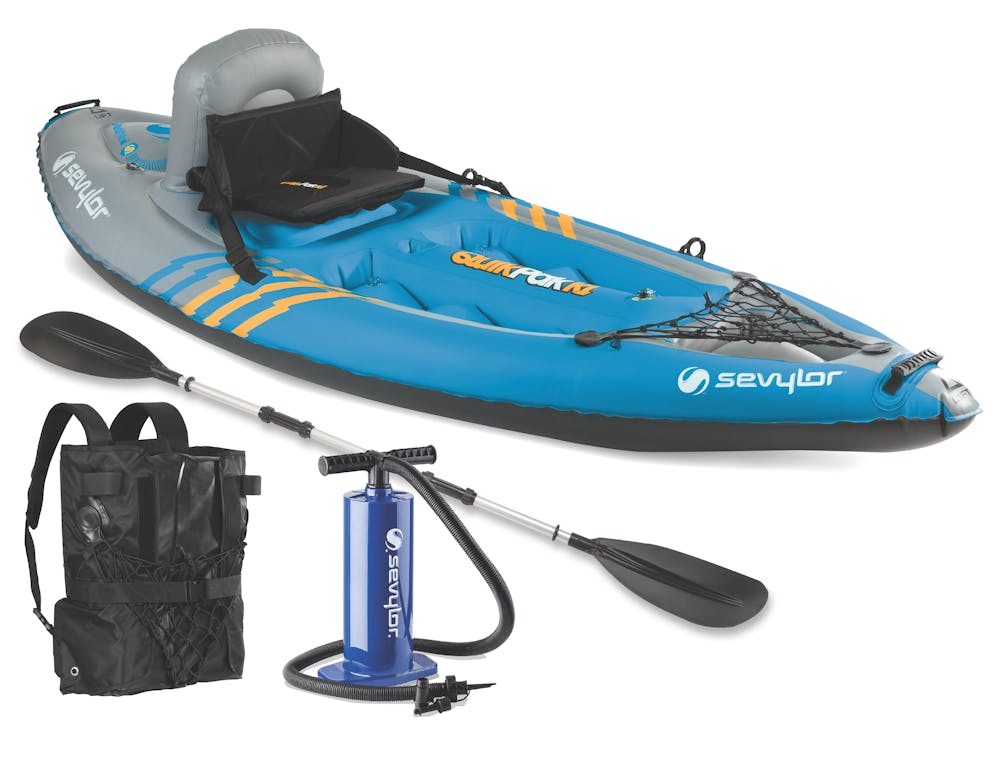
Some bundles include a paddle and pump; check before buying them separately.
The QuikPak K1's idea is simple and useful: the backpack it is carried in becomes the seat back once inflated. It is the easiest boat here to take on a short walk to the water or keep in a small apartment. It is also a short, recreational boat that is best on calm, sheltered water; it will not track or keep up like the longer boats.
Pros
- ✓Carry bag doubles as the seat back
- ✓Light and quick to set up
- ✓Low price
Cons
- ✗Short hull limits speed and tracking
- ✗Suited to calm water only
Hull stiffness: drop-stitch floors and pressure decide how it paddles
An inflatable kayak paddles as well as it holds its shape. A basic tube-and-I-beam boat runs at low pressure, so the floor sags under your hips and the hull bends slightly with each stroke. That flex wastes effort and makes the boat feel slow even when the length says it should be quick.
Drop-stitch construction fixes most of this. Thousands of threads join the top and bottom layers, which lets the chamber be pumped much harder and stay flat, like a paddle board. A drop-stitch floor under a tube hull is the common middle ground; a boat built mostly from drop-stitch panels, like the RazorLite, is the stiff end of the market.
The practical rule: check the recommended pressure on the spec sheet, not just the words "high pressure". A floor rated at several PSI behaves very differently from tubes rated at a fraction of one, and the gap shows up in both speed and comfort.
Tracking: why some inflatables wander and others go straight
Tracking is how well the kayak holds a straight line between strokes, and it is the most common complaint in owner reviews of cheap inflatables. A short, wide, round-bottomed boat yaws left and right with every stroke, and a crosswind makes it worse because there is nothing below the waterline to grip.
There are three fixes, in rising order of effectiveness: a removable skeg under the stern, a longer hull, and rigid elements that give the bow a defined keel line. The AdvancedFrame's aluminum ribs are the clearest example of the third, which is why it tracks better than its length suggests. Whatever you buy, fit the skeg every time — most bad tracking reviews come from paddling without it.
Capacity versus length: read the spec sheet carefully
Rated capacity is the total load at which the boat is still safe, not a comfortable working load. Paddler, gear, water and a dog add up quickly, and an inflatable loaded close to its rating sits low, paddles heavily and takes water over the sides in chop. Plan to stay well under the figure.
Two-person inflatables are usually sold on their headline capacity, but seating two adults puts the bow paddler's knees close to the rear paddler's blade. The Intex Excursion Pro is a comfortable one-person-plus-gear boat and a tight two-adult boat. Longer boats also carry more speed, so if you plan to paddle alone and cover distance, length is worth more than extra width.
Portability, setup and safety on the water
The reason to buy an inflatable is that it fits in a closet and a car, so packed weight and setup time are real buying criteria. Setup for any of these boats takes roughly ten to twenty minutes with a hand pump; the most-repeated review complaint is the bundled pump, and a better double-action pump is often the first upgrade owners make. Dry the boat fully before storing it, or mildew will reach the seams.
On the water, inflatables sit high and catch the wind more than hard-shell kayaks, so plan routes that return upwind and avoid open water in offshore breezes. Wear a buoyancy aid every time, and in cold water dress for immersion rather than air temperature — a capsize in cold water is dangerous long before hypothermia sets in.
Frequently asked questions
Are inflatable kayaks as good as hard-shell kayaks?▼
How long does an inflatable kayak last?▼
Can an inflatable kayak be punctured by a fishing hook or a rock?▼
Do I need a life jacket in an inflatable kayak?▼
Prices change. Check the retailer for the current price.
Comments & questions
Discussion happens on nattzy, our community forum. Sign in with Google to post — it takes a second.
Still deciding? Ask the community your own question — Post a question on nattzy ↗