Best Cordless Drill 2026: 5 Drill/Drivers for Home Compared
Most people buy a drill that is either too much or too little for what they actually do at home. The right one is decided less by its torque figure than by its battery platform, its weight and its chuck.
Quick answer
The DEWALT DCD791D2 is the drill to buy for most homes: a brushless 1/2-inch drill/driver with two batteries in the kit, enough power for masonry anchors and hole saws, and the 20V MAX platform, one of the largest cordless tool ranges in the US. Makita's XFD131 is the lighter-feeling equal on 18V, Milwaukee's M12 2407 and Bosch's GSR12V-300 are the compact 12V choices for furniture and fixtures, and BLACK+DECKER's LDX120C is the budget drill for occasional use.
We did not run our own testing on these drills. A fair comparison would need a dynamometer for stall torque, a controlled drilling rig in consistent materials and a way to cycle batteries to end of life, none of which we have. What we did instead: took voltage, chuck size, motor type, speed ranges and kit contents from each manufacturer's product pages and manuals, checked current pricing at major US retailers, and read owner reviews in volume, keeping only repeated, specific complaints — chucks that slip, batteries that fade within a year, clutches that stop disengaging — rather than first-day impressions. Torque figures are manufacturer claims, measured in different ways by different brands, and we say so wherever we quote one.
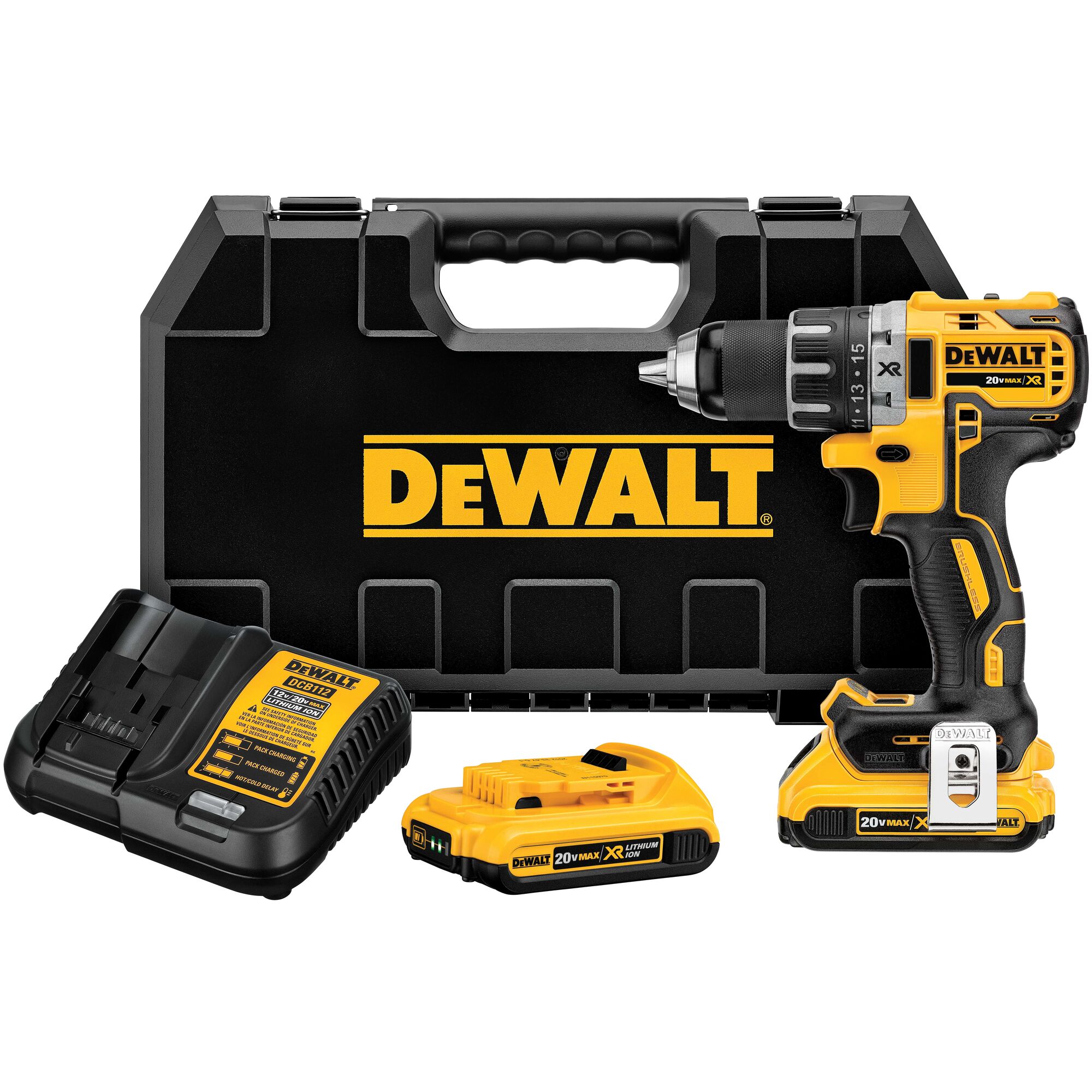
🏆 Best overall: The DCD791D2 is the pick because it is the most complete household package: a brushless 1/2-inch drill/driver with two speed ranges, two 2.0Ah batteries in the kit, and the 20V MAX platform, which gives the widest choice of follow-up tools in most US hardware stores. The compact 2.0Ah packs keep it reasonably light; if you mainly drill large holes, a bigger battery is the upgrade to consider.
Top picks ↓| Product | Price | Link |
|---|---|---|
| $149〜$229Reference price | ||
| $149〜$229Reference price | ||
| $99〜$169Reference price | ||
| $99〜$179Reference price | ||
| $39〜$69Reference price |
Top picks
Related articles


DEWALT 20V MAX XR Brushless Drill/Driver Kit (DCD791D2)
D2 means two 2.0Ah batteries; the DCD791B is the bare tool with no battery or charger.
The DCD791D2 is the pick because it is the most complete household package: a brushless 1/2-inch drill/driver with two speed ranges, two 2.0Ah batteries in the kit, and the 20V MAX platform, which gives the widest choice of follow-up tools in most US hardware stores. The compact 2.0Ah packs keep it reasonably light; if you mainly drill large holes, a bigger battery is the upgrade to consider.
Pros
- ✓Brushless motor with two speed ranges
- ✓Two batteries in the kit
- ✓Huge 20V MAX tool ecosystem
Cons
- ✗Heavier than any 12V drill
- ✗Small 2.0Ah batteries run down on big jobs

Makita 18V LXT Brushless 1/2" Drill/Driver Kit (XFD131)
Makita sells this drill in several kit configurations — confirm the battery count before buying.
The Makita XFD131 is a compact brushless 1/2-inch drill/driver on the 18V LXT platform, rated by Makita at 440 in-lbs of maximum torque. It has a reputation among owners for balance and a smooth, predictable clutch, and LXT is one of the broadest battery platforms available, including outdoor tools and mowers. Check the kit contents carefully, as battery count differs between listings.
Pros
- ✓Compact, well-balanced brushless design
- ✓1/2-inch chuck for larger bits
- ✓Broad 18V LXT platform
Cons
- ✗Battery count varies between listings
- ✗Priced like the DEWALT with fewer kit extras
Milwaukee M12 3/8" Drill/Driver Kit (2407-22)
The -22 suffix is the kit with two batteries; -20 is the bare tool.
The Milwaukee 2407-22 is the classic 12V drill for home fixing jobs: small, light and easy to use inside cabinets or overhead, with a 3/8-inch chuck and a manufacturer rating of 275 in-lbs. The kit includes two batteries, and the M12 platform has an unusually wide range of small tools. It is a brushed motor and it will struggle with large holes in hardwood or masonry.
Pros
- ✓Very light and compact
- ✓Two batteries in the kit
- ✓Large M12 compact-tool range
Cons
- ✗Brushed motor, not brushless
- ✗Limited on large holes and masonry
Subscribe to our newsletter
Occasional updates and new releases — no spam.

Bosch 12V Max Brushless 3/8" Drill/Driver Kit (GSR12V-300B22)
B22 indicates the kit with two 2.0Ah batteries; the bare tool has a different suffix.
The Bosch GSR12V-300 is a brushless 12V drill/driver with a 3/8-inch chuck and a manufacturer rating of 300 in-lbs, sold with two 2.0Ah batteries. It sits between the Milwaukee M12 and the 18V drills: still light enough for overhead work, but with brushless efficiency for longer run time per charge. Bosch's 12V tool range in the US is narrower than Milwaukee's.
Pros
- ✓Brushless motor at 12V size
- ✓Two 2.0Ah batteries in the kit
- ✓Light enough for overhead work
Cons
- ✗Smaller US tool range than M12
- ✗3/8-inch chuck limits larger bits

BLACK+DECKER 20V MAX Cordless Drill/Driver (LDX120C)
Often bundled with bits or accessories under different listings; the drill itself is the same.
The LDX120C is the drill for someone who hangs a picture twice a year and assembles the occasional flat-pack. It is inexpensive, light and simple, with a 3/8-inch chuck, one battery and a basic charger. The brushed motor and slow charger are the trade-offs, and it is not compatible with DEWALT batteries despite the shared 20V MAX label.
Pros
- ✓Very low price
- ✓Light and easy for beginners
- ✓Fine for furniture and pilot holes
Cons
- ✗Brushed motor and single battery
- ✗Not for masonry or large holes
The battery platform matters more than the drill
A drill is usually the first cordless tool someone buys, which means it quietly decides every tool after it. Batteries do not cross brands, so the impact driver, circular saw, vacuum or even lawn mower you add later will be cheapest on the platform you start with. The drill itself is the smaller half of the decision.
DEWALT 20V MAX, Makita 18V LXT and Milwaukee's M12 and M18 lines are the three broadest professional-grade platforms in the US, and all three have household tools as well as trade ones. Bosch's 12V and 18V ranges are solid but smaller in the US. BLACK+DECKER's 20V MAX range is aimed at home use and is not compatible with DEWALT batteries despite the similar name.
Note that '20V MAX' and '18V' describe the same class of battery: 20V is the peak voltage with no load, 18V the nominal figure. There is no real power difference implied by the name.
12V or 18V/20V: size the drill to the jobs
A 12V drill is smaller, lighter and easier to hold overhead or inside a cabinet. For assembling furniture, hanging shelves and curtain rails into studs, and drilling pilot holes, a good 12V brushless model does everything most households ever ask of a drill, with less fatigue.
An 18V or 20V drill earns its extra weight when the job is hard: large-diameter holes with spade bits or hole saws, long screws into framing timber, or drilling concrete and brick for wall anchors with a hammer-drill setting. If you expect to do renovation work rather than occasional fixes, start with the larger platform.
Many owners end up with both. If you are unsure, a 12V drill paired later with a larger impact driver is often a better use of money than one heavy drill used for everything.
Torque, speed and chuck size
Torque figures are the least comparable number on a drill box. Makita, Milwaukee and Bosch quote inch-pounds, while DEWALT rates its drills in 'unit watts out', a separate system that cannot be converted directly. Use torque only to compare models within the same brand, and treat it as a manufacturer claim, not a measured result.
Chuck size is more telling. A 1/2-inch chuck, found on the DEWALT and Makita here, accepts larger bits and grips them harder under load; a 3/8-inch chuck, found on the 12V models and the BLACK+DECKER, is lighter and entirely adequate for household bits. Two speed ranges matter as well: the low range is for driving screws with control, the high range for drilling.
The clutch is the setting that protects your work. A good adjustable clutch stops driving at a consistent point so you do not strip screw heads or sink them through soft materials, and in owner reviews the budget drills are where clutch consistency is most often questioned.
Brushless motors and what the kit includes
Brushless motors run cooler, deliver more of the battery's energy as work, and do not wear carbon brushes. Four of the five drills here are brushless; the BLACK+DECKER is a brushed motor, which is part of why it costs so little. For a drill used a few times a year, a brushed motor is fine; for regular use, brushless is worth the premium.
Kit contents vary more than the drills. Two batteries mean one can charge while the other works, which matters more on a long job than a slightly bigger single battery. Check listings carefully, because the same drill is often sold bare, with one battery or with two, and the difference in price is mostly the battery.
Frequently asked questions
Do I need a hammer drill for home use?▼
Drill/driver or impact driver?▼
How long do cordless drill batteries last?▼
Can I use a DEWALT battery in a BLACK+DECKER drill?▼
Prices change. Check the retailer for the current price.
Comments & questions
Discussion happens on nattzy, our community forum. Sign in with Google to post — it takes a second.
Still deciding? Ask the community your own question — Post a question on nattzy ↗