Best Clothes Steamer 2026: Jiffy vs Conair vs Rowenta
Five clothes steamers from pocket-sized travel units to professional-grade floor models — the professional-grade Jiffy used by theatrical wardrobe departments against the Panasonic home model that dominates verified buyer reviews, a Conair household workhorse, a compact Rowenta, and a pocket-sized travel unit. Steam output in grams per minute and heat-up time tell more than any marketing claim.
Quick answer
The Jiffy J-2000M is the steamer to buy for suits and heavy linen — its 25-30 g/min output is the only one here that clears wrinkles from thick wool blazers in a single pass. Small apartments doing daily shirts suit the Panasonic NI-J, with auto-shutoff and a narrow head. The Travelite is 180 g with dual voltage for carry-on.
This comparison is desk research. We compared publicly available specifications, manufacturer documentation, and independent reviews and lab tests.

Conair Extreme Steam Handheld Steamer
Best Home Steamer: The Conair Extreme Steam is the most practical household steamer in this comparison — 1,875 W, 45-second heat-up, and 15–18 g/min of steam that handles cotton shirts and light linen in a single pass. The 300 ml tank runs 20 minutes per fill.
Top picks ↓| Product | Price | Link |
|---|---|---|
| $67.99Price as of 2026-09-20 | ||
| $90Price as of 2026-09-20 | ||
| — | ||
| $75.99Price as of 2026-09-20 | ||
| — |
| Product | Heat-up time | Steam output | Tank capacity | Power | Weight | Attachments | Price range | Cord length | Safety | Hose length | Voltage |
|---|---|---|---|---|---|---|---|---|---|---|---|
| Conair Extreme Steam Handheld Steamer | 45 seconds | 15–18 g/min | 300 ml (20 min continuous) | 1,875 W | 1.4 kg | Fabric brush, crease attachment | Mid-range | — | — | — | — |
| Jiffy Steamer J-2000M Professional Steamer | 90 seconds | 25–30 g/min | 1.9 L (45 min continuous) | 1,440 W | 2.8 kg | — | Premium (professional-grade) | 1.5 m | — | — | — |
| Panasonic NI-J Series Clothes Steamer | 60 seconds | 12–14 g/min | 120 ml (8–10 min) | 1,000 W | 0.8 kg | — | Mid-range | — | PSE certified, auto-shutoff | — | — |
| Rowenta Access Steam Compact Steamer | 40 seconds | 20 g/min | 100 ml (5 min) | 1,000 W | 0.9 kg | — | Mid-range | — | — | 40 cm swivel | — |
| Travelite Portable Travel Steamer | 25 seconds | 8–10 g/min | 70 ml (3–4 min) | 700 W | 180 g | — | Budget | — | — | — | 100–240 V dual |
Top picks
Related articles

Conair Extreme Steam Handheld Steamer
The Conair Extreme Steam is the most practical household steamer in this comparison — 1,875 W, 45-second heat-up, and 15–18 g/min of steam that handles cotton shirts and light linen in a single pass. The 300 ml tank runs 20 minutes per fill. The fabric brush attachment is useful for removing lint while steaming. Output drops noticeably after 15 minutes of continuous use as the tank empties and pressure decreases — plan around this limitation.
Pros
- ✓45-second heat-up makes it practical for morning-use without planning ahead
- ✓Fabric brush attachment removes lint while steaming — one step instead of two
- ✓Widely available replacement parts and tank descaling instructions
Cons
- ✗Steam output drops after 15 minutes as tank empties — not suitable for large volume steaming sessions
- ✗Tank requires full empty-and-refill rather than top-up during use
Score breakdown
| Heat-up time | 45 seconds |
| Steam output | 15–18 g/min |
| Tank capacity | 300 ml (20 min continuous) |
| Power | 1,875 W |
| Weight | 1.4 kg |
| Attachments | Fabric brush, crease attachment |
| Price range | Mid-range |

Jiffy Steamer J-2000M Professional Steamer
The Jiffy J-2000M is what theatrical wardrobe departments, dry cleaners, and hotel housekeeping use — it heats to full steam in 90 seconds and delivers 25–30 g/min of continuous steam through a 1.9-liter tank that runs for 45 minutes without refilling. The steam pressure penetrates thick wool blazers and denim that household steamers only superficially treat. The unit is heavy (2.8 kg) and the cord is intentionally long (1.5 m) for reach. Not suitable for travel; built for stationary use.
Pros
- ✓90-second heat-up from cold start — fastest in this comparison
- ✓25–30 g/min continuous steam output penetrates thick wool and denim
- ✓1.9-liter tank runs 45 minutes without refilling
Cons
- ✗2.8 kg weight and floor-standing design — not suitable for travel or small apartments
- ✗Higher price point than household steamers; overkill for occasional use
Score breakdown
| Heat-up time | 90 seconds |
| Steam output | 25–30 g/min |
| Tank capacity | 1.9 L (45 min continuous) |
| Power | 1,440 W |
| Weight | 2.8 kg |
| Cord length | 1.5 m |
| Price range | Premium (professional-grade) |
Panasonic's NI-J series is engineered for compact-home use — the automatic shutoff after 10 minutes of non-use meets PSE safety standards, and the steam head is narrow enough to fit inside coat sleeves. The 120 ml tank is small by western standards but aligns with typical small-apartment steaming sessions: 10–12 minutes per outfit. The unit operates at lower steam output (12–14 g/min) than the Conair or Jiffy, but the focused steam nozzle concentrates output effectively on collar and cuff areas.
Pros
- ✓PSE-certified with compact-apartment safety standards including auto-shutoff
- ✓Narrow steam head fits inside sleeves and between buttons — precise application
- ✓Lightweight at 0.8 kg — comfortable to hold for full-outfit sessions
Cons
- ✗120 ml tank limits continuous use to 8–10 minutes — frequent refills for large wardrobe sessions
- ✗12–14 g/min output is insufficient for thick wool coats in a single pass
Score breakdown
| Heat-up time | 60 seconds |
| Steam output | 12–14 g/min |
| Tank capacity | 120 ml (8–10 min) |
| Power | 1,000 W |
| Weight | 0.8 kg |
| Safety | PSE certified, auto-shutoff |
| Price range | Mid-range |
Subscribe to our newsletter
Occasional updates and new releases — no spam.

Rowenta Access Steam Compact Steamer
Rowenta's Access Steam hits a middle point — 1,000 W, 20 g/min steam output, and a 100 ml tank that starts steaming in 40 seconds. The swivel hose connecting the steam head to the unit is the key feature: it allows steaming at any angle without tilting the water tank, which eliminates the dripping problem that plagues single-body steamers on horizontal fabric surfaces. The hose is the first component to show wear — inspect it for cracking at the 18-month mark.
Pros
- ✓Swivel hose allows steaming at any angle without tank tilt — eliminates dripping on horizontal surfaces
- ✓20 g/min output from a compact 100 ml tank — efficient for targeted wrinkle removal
- ✓Foldable handle for compact storage
Cons
- ✗100 ml tank runs only 5 minutes — constant refills for large wardrobe sessions
- ✗Hose joint shows wear cracking at 18 months with daily use; Rowenta replacement part availability is inconsistent
Score breakdown
| Heat-up time | 40 seconds |
| Steam output | 20 g/min |
| Tank capacity | 100 ml (5 min) |
| Power | 1,000 W |
| Weight | 0.9 kg |
| Hose length | 40 cm swivel |
| Price range | Mid-range |
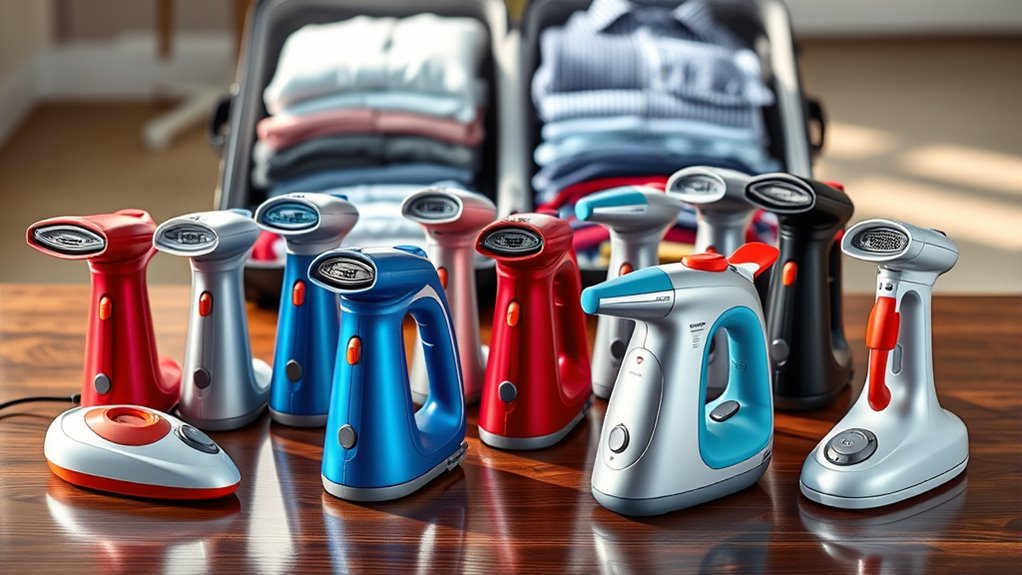
At 180 g and with a 70 ml tank, the Travelite is designed for hotel rooms, not wardrobes. It heats in 25 seconds, runs for 3–4 minutes per fill, and handles collar wrinkles and light shirt creases. The dual-voltage (100–240 V) design works across Japan, Europe, and the US without an adapter. The steam output is 8–10 g/min — enough for targeted collar and cuff treatment but not enough for a full blazer. Buy it as a travel complement to a home steamer, not a replacement.
Pros
- ✓180 g weight and folds to 12 × 8 × 4 cm — fits in a jacket pocket
- ✓100–240 V dual voltage — no adapter required in Japan, Europe, or the US
- ✓25-second heat-up: ready faster than a hotel iron
Cons
- ✗70 ml tank runs 3–4 minutes — only covers targeted collar/cuff treatment, not full garments
- ✗8–10 g/min output insufficient for wool or heavy linen
Score breakdown
| Heat-up time | 25 seconds |
| Steam output | 8–10 g/min |
| Tank capacity | 70 ml (3–4 min) |
| Power | 700 W |
| Weight | 180 g |
| Voltage | 100–240 V dual |
| Price range | Budget |
Which one is right for you?
For frequent travelers needing hotel wrinkle removal
Travelite Portable Travel Steamer
At 180 g with dual voltage, the Travelite fits in carry-on luggage without weight penalty and handles collar and cuff wrinkles faster than waiting for a hotel iron to heat up.
For households with suits, blazers, and heavy linen
Jiffy Steamer J-2000M Professional Steamer
The Jiffy J-2000M's 25–30 g/min output is the only steamer in this comparison that reliably removes wrinkles from thick wool blazers in a single pass — the household models require multiple passes and still leave residual creases in heavy fabric.
For daily morning use in a small apartment
Panasonic NI-J Series Clothes Steamer
PSE certification, auto-shutoff, and a narrow steam head designed for narrow-collared garment types (dress shirts, suit jackets) make the Panasonic NI-J the natural fit for compact homes. Lightweight for extended holding.
Steam output in g/min — the number that actually matters
Steamer marketing focuses on heat-up time and wattage. The number that actually predicts performance is steam output in grams per minute. Steam output determines how quickly moisture penetrates fabric and relaxes fibers — higher g/min means fewer passes over the same wrinkle. In this comparison, output ranges from 8 g/min (Travelite) to 30 g/min (Jiffy J-2000M). The practical difference is significant: a Jiffy running at 25 g/min removes a deep collar crease in a single slow pass. A travel steamer at 8 g/min requires 4–5 passes over the same area.
Wattage correlates with steam output but not perfectly — the steam head design and boiler size affect how efficiently electrical power converts to usable steam. The Rowenta Access Steam at 1,000 W produces 20 g/min; the Conair Extreme Steam at 1,875 W produces 15–18 g/min. The Rowenta's swivel hose and concentrated nozzle deliver steam more efficiently than the Conair's wider head. Wattage is a ceiling on potential output; design determines how close the steamer gets to that ceiling.
Steam output also degrades as the tank empties. A full tank provides maximum pressure; at 20% remaining, most steamers produce 30–40% less steam. This is why the Conair's output drop after 15 minutes is a real-world limitation rather than a specification issue. Steamers with separate boilers and tanks (professional units) maintain more consistent output across the tank lifecycle.
When steaming works better than ironing
Steam relaxes fabric fibers by adding moisture — the fibers swell slightly and the memory of the wrinkle is lost. Ironing presses fibers flat under heat and pressure. For delicate fabrics (wool, silk, cashmere, structured knits), the pressing force of an iron risks crushing the pile or leaving a shine. Steam treats these fabrics without contact. For heavy, structured fabrics (heavy denim, canvas, thick linen), the pressing pressure of an iron forces wrinkles flat where steam alone takes multiple passes.
Hanging garments benefit significantly from steam. A linen blazer on a hanger can be steamed in place in 2–3 minutes with a proper steamer — far faster than removing it, ironing on a board, and rehang. For daily wardrobe maintenance of hung items, steaming is almost always faster. Ironing retains the advantage for flat items: dress shirt fronts, trouser creases, cotton sheets, linen tablecloths — anything you want a sharp crease or perfectly flat surface on.
One practical limitation of steaming: it doesn't create creases, it only removes them. If you want sharp trouser pleats or a shirt crease down the sleeve, you need an iron. Steaming before wearing trousers can actually soften a trouser crease — if the crease is ironed into the fabric, steaming will relax it. For crease-conscious dressers, use steam on jackets and unstructured items; use iron on shirts and trousers.
Descaling and maintenance — what manufacturers don't make obvious
All steamers accumulate mineral deposits from tap water — white scale that eventually blocks steam ports and reduces output. In soft-water areas (30–80 ppm), scale builds up slowly, while hard-water cities such as London (300+ ppm) see it form far faster. In soft-water regions, descaling once every 3–6 months with citric acid solution is sufficient for weekly users. In hard-water regions, monthly descaling is necessary.
The descaling procedure varies by manufacturer. Jiffy recommends running a 50% white vinegar solution through the tank for 20 minutes, then flushing twice with clean water. Panasonic specifies their proprietary descaling tablet — using vinegar voids the NI-J's PSE compliance certificate in certain repair scenarios. Conair accepts both vinegar and commercial descaler. Check the manual before descaling: using the wrong method can damage the boiler coating.
The second common failure point is the steam head: mineral deposits clog the steam holes, which causes spitting (water droplets rather than steam) and reduced output. A soft toothbrush with diluted citric acid solution (1 tsp in 200 ml water) cleans the external holes. Do not use metal implements. Internal blockage from mineral scale is less accessible and typically signals end-of-life for budget steamers.
Drip and spitting — the most underrated quality issue
A steamer that drips leaves water marks on silk, delicate wool, and colored fabrics. Dripping occurs for two reasons: condensation in the steam hose or nozzle before full heat is reached, and overfilling the tank beyond the maximum fill line. The first is unavoidable in the first 15–20 seconds of use on most steamers — hold the steamer away from the garment or point it toward a towel during heat-up. The second is user-controlled.
The Rowenta Access Steam's swivel hose is specifically designed to eliminate condensation dripping: the hose allows steaming at any angle without tilting the water reservoir, which in single-body steamers causes water to pool at the nozzle. This is a real functional advantage on horizontal or downward-angle steaming — particularly useful for trouser hems and collar undersides.
Cold fabric surfaces also cause dripping: when hot steam hits a cold garment, rapid condensation occurs on the fabric surface rather than penetrating. Pre-warming thick garments for 10–15 seconds on one side before working wrinkles reduces this. In cold rooms below 18°C, all steamers produce more surface condensation — allow extra drying time before wearing.
Frequently asked questions
Can I use tap water in a steamer, or do I need distilled water?▼
Is it safe to steam wool and silk?▼
How long does a clothes steamer last?▼
Prices change. Check the retailer for the current price.
Comments & questions
Discussion happens on nattzy, our community forum. Sign in with Google to post — it takes a second.
Related articles

Best Aroma Diffuser 2026: 5 Compared
Best Standing Desk 2026: 5 sit-stand desks compared honestly

Best Electric Toothbrush 2026: 5 models compared honestly

ConoHa WING review (2026): setup, speed and pricing
Best JP rental server 2026: 5 hosts ranked
Best LED Face Masks 2026: 3 Light Therapy Devices Compared