Best Baby Food Maker 2026: 5 Machines Side-by-Side
The gap between first and last place is wider than any spec sheet suggests. This guide compares 5 options using published specifications, manufacturer documentation and independent reviews.
Quick answer
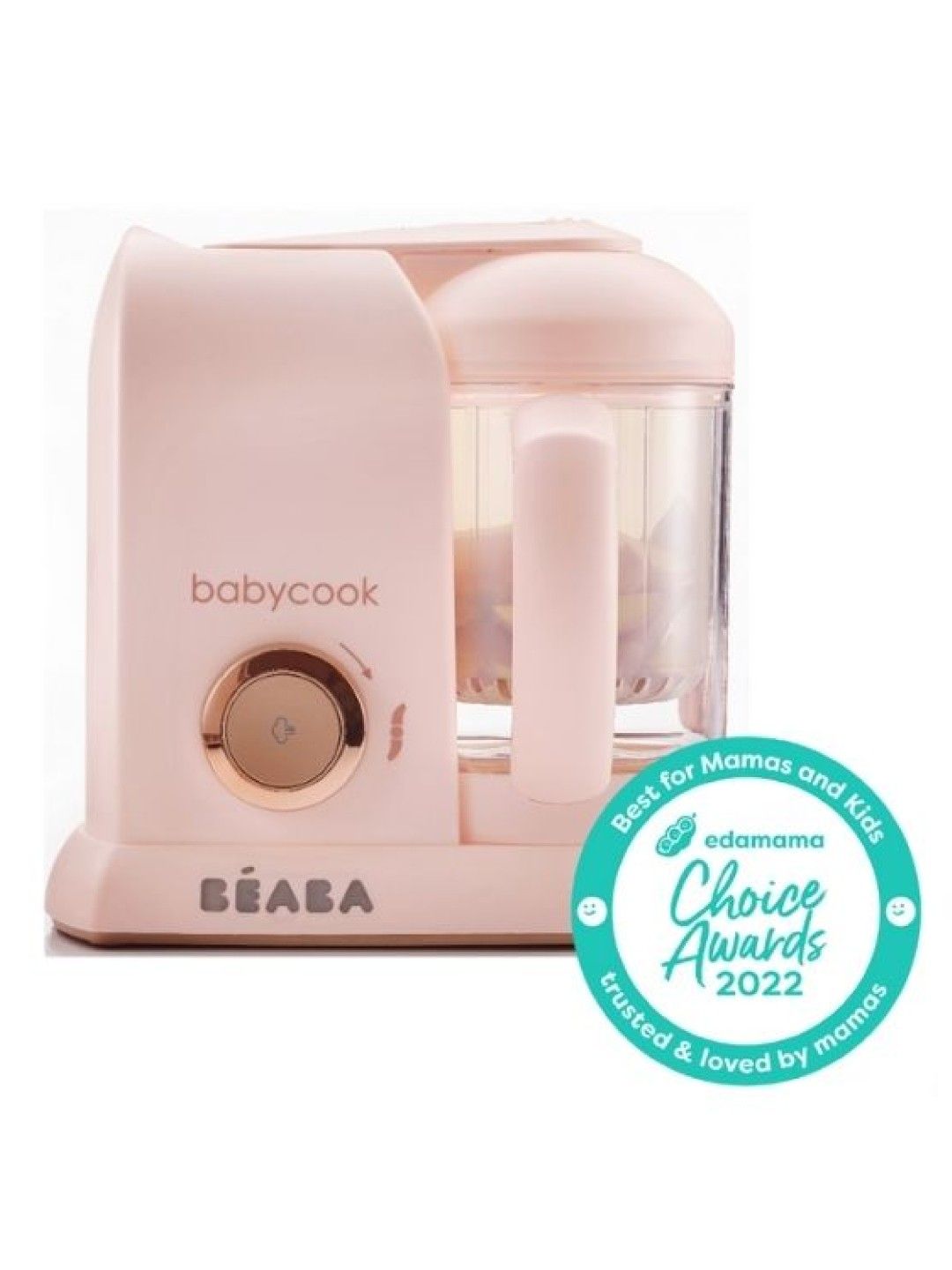
The Béaba Babycook Solo is the best baby food maker for most parents, and the only one here with a borosilicate glass bowl — it holds no odors and does not stain after dozens of sweet-potato batches. Soft vegetables reach puree texture in 8-10 minutes, chicken in 18-20. Expect $150-180, roughly double the plastic-bowl machines.
This comparison is desk research. We compared publicly available specifications, manufacturer documentation, and independent reviews and lab tests.
Béaba Babycook Solo
No partner store here — this opens an Amazon search.
| Product | Price | Link |
|---|---|---|
| $150〜$200Reference price | No partner store here — this opens an Amazon search. | |
| $90.24Price as of 2026-09-20 | ||
| $70〜$100Reference price | ||
| $99.87Price as of 2026-09-20 | ||
| $50〜$75Reference price |
Top picks
Related articles


Glass bowl, BPA-free, French-certified materials; ships from beabausa.com with 2-year warranty. Best all-in-one for texture quality.

Largest capacity (5.5 cups), auto-blend walks away unattended; available at babybrezza.com and major US retailers. Best for high-volume families.
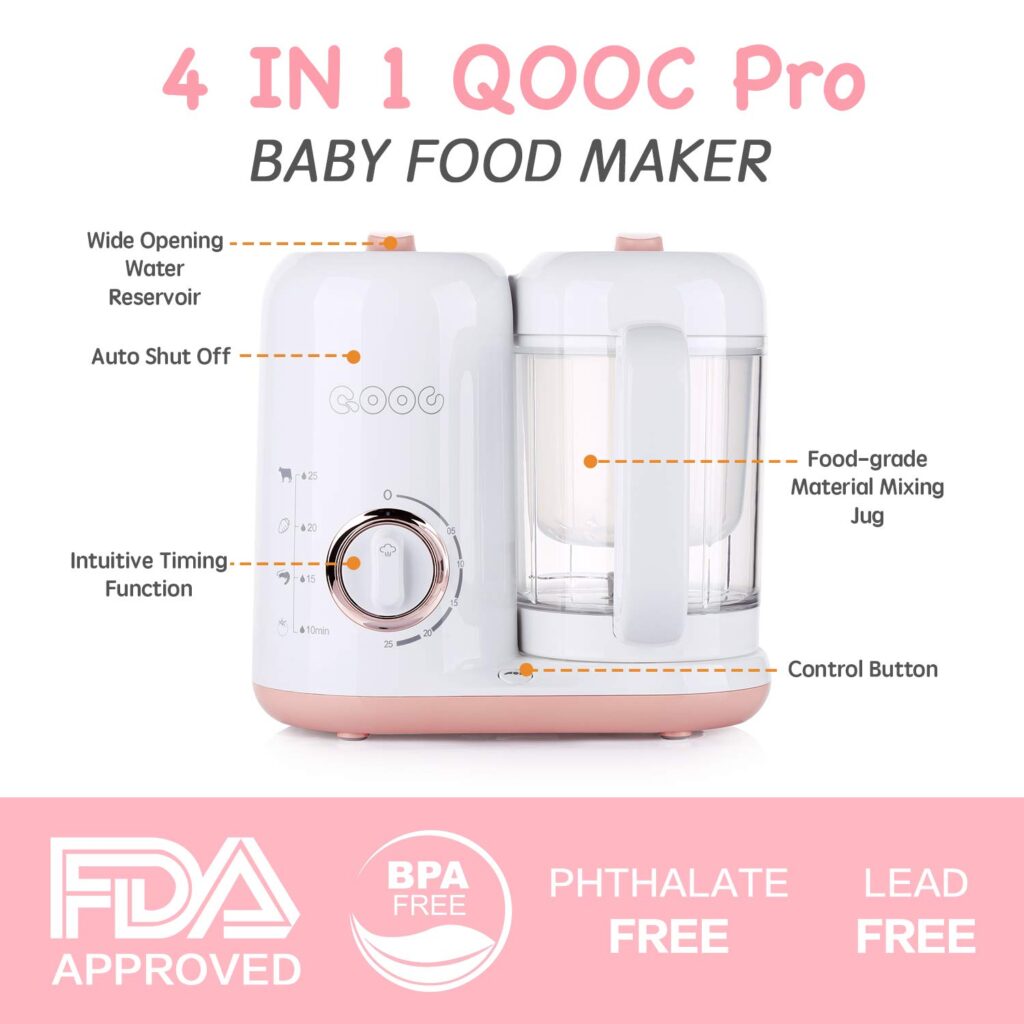
4-in-1 with defrost and reheat; smallest footprint (5.5×5.5 in base); order direct from qooc.us. Best for apartments and small kitchens.
Subscribe to our newsletter
Occasional updates and new releases — no spam.

600W motor handles frozen fruit, nut butter, and family smoothies long after baby food phase ends; at nutribullet.com. Best blender-only system.

20-piece complete starter bundle including 6 date-dial storage cups; lowest entry price at $50–$75 from babybullet.com. Best budget pick.
How we compared five baby food makers
The five machines fall into two camps: all-in-one steamers-plus-blenders (Béaba Babycook Solo, Baby Brezza One Step, QOOC Mini) and blender-only systems (NutriBullet Baby, Magic Bullet Baby Bullet). All-in-ones do everything in a single bowl, which means one fewer piece to wash. Blender-only units are faster at actual blending but require you to steam vegetables separately on the stovetop or in a microwave. | Machine | Price | Key strength | Verdict | |---|---|---|---| | Béaba Babycook Solo | $150–$180 | Smooth texture, BPA-free glass bowl | Best all-in-one | | Baby Brezza One Step | $100–$140 | Largest capacity, truly hands-free | Best for volume | | QOOC Mini | $70–$100 | Compact footprint, 4-in-1 | Best for small kitchens | | NutriBullet Baby | $80–$120 | 600W motor, batch freezing | Best blender-only | | Magic Bullet Baby Bullet | $50–$75 | 20-piece set, storage included | Best budget pick |
The split matters most in hands-on time. The Baby Brezza steams and blends in one unattended cycle, so you press the button once and walk away. The Béaba and QOOC Mini need you to come back and start the blend yourself. The two blender-only units are the quickest at the blending step, but you have to steam the vegetables separately first, which adds stovetop or microwave time to every session.
Béaba Babycook Solo — best all-in-one for texture quality
The Babycook Solo costs $150–$180 and has earned its reputation over 30 years of production. The bowl is borosilicate glass, not plastic — the only machine here that is. That matters practically: glass retains no odors and resists staining from sweet potato or butternut squash after dozens of batches. The bowl capacity is 4.7 cups (1,100 mL) usable, which covers a single-serve puree to a three-day batch for an early eater.
Steam performance is the standout. Soft vegetables like zucchini and peas reach puree-ready texture in 8–10 minutes. Chicken breast takes 18–20 minutes but comes out genuinely smooth — not grainy — when blended immediately in the same bowl. The blade is a single flat unit that pops out for hand-washing.
The BPA-free, phthalate-free certification is audited by French regulatory bodies, not self-certified. For parents who care about that, it is the safest materials story in this comparison. The machine is CE- and FDA-compliant and ships with a two-year warranty honored through the US-based beabausa.com distributor.
The downside is real: at $150–$180 it is the most expensive machine here, and the bowl's 4.7-cup capacity is smaller than the Baby Brezza's 5.5-cup bowl. Families batch-cooking for a four to six month freezer stock will hit capacity limits faster. The power cord is also non-removable, which makes storage slightly awkward in tight kitchens.
Baby Brezza One Step — best for high-volume, hands-free batches
The Baby Brezza One Step ($100–$140) is the least demanding machine to operate once you understand its single-button logic. Add food, add water, push the button. The machine steams, then automatically switches to blend without any intervention, so it can be left alone until the puree is finished.
Capacity is the largest in this comparison at 5.5 cups (1,300 mL). For a family freezing in silicone trays — 1 oz per cube, 14 cubes per tray — that is roughly 7.5 cups of finished puree per batch when blending with steam water. That covers three to four days of feeding for a six to eight month old at 2–3 oz per meal, two meals per day.
Cleanup is the quickest here: the bowl, blade, and lid are all dishwasher-safe on the top rack. The plastic is BPA-free and Tritan-based. Texture on dense vegetables like carrot comes out slightly less smooth than the Béaba's glass-bowl result — a small but consistent difference owners mention with firmer vegetables.
The machine is made of plastic throughout. Some parents find the BPA-free-but-still-plastic construction less reassuring than the Béaba's glass bowl, and that concern is legitimate. The cord length at 27 inches is also short for kitchens where outlets sit more than two feet from the counter edge.
QOOC Mini Baby Food Maker — best for apartments and small kitchens
The QOOC Mini ($70–$100) is the only machine here that stores upright in a standard 12-inch deep cabinet without rearranging anything. Its footprint is 5.5 × 5.5 inches at the base — smaller than a liter of milk. That matters in real small apartment kitchens where counter space is a genuine constraint.
The four functions — steam, blend, defrost, and reheat — are selected by a single dial. Defrost and reheat are the functions you will not find on the Baby Brezza or Béaba. Defrost on frozen sweet potato cubes runs 4–5 minutes and produces a warm, spoonable texture without the separation you get from microwave defrost.
Batch size is smaller: the bowl holds 3.5 cups (825 mL), which produces about 2.5 cups of finished puree. For a family batch-cooking once a week, that means two to three runs per session instead of one. Steam time on dense root vegetables also runs longer than the Baby Brezza's — a difference owners notice when working through carrot or sweet potato.
The blade assembly has four parts compared to the Béaba's one-piece blade, so every cleanup takes longer — the most common complaint in owner reviews of this machine. Not a dealbreaker, but worth factoring in against the space savings.
NutriBullet Baby — best blender-only system for batch cooking
The NutriBullet Baby ($80–$120) is not a dedicated baby food appliance in the traditional sense — it is the 600W NutriBullet Pro motor base paired with baby-specific short cups (32 oz, 18 oz), a storage lid set, and a date-marking disc. The motor is four to six times more powerful than the dedicated steamers' blending motors.
At 600W it takes frozen mango chunks to a smooth puree in seconds, and pre-steamed carrot to a texture owners describe as indistinguishable from the Béaba's. Cooked chicken thigh blends smooth with a splash of cooking liquid added. The machine can handle jobs the dedicated all-in-ones cannot: nut butters, smoothie pouches for toddlers, hummus for the rest of the family.
The limitation is structural: you must steam or cook food separately before blending. That adds 10–20 minutes of stovetop or microwave time to each session. The 600W motor also generates real heat during extended blending — owners note the cup is warm after a long run — which means you cannot blend directly from the cooking vessel the way you can with the all-in-ones.
The NutriBullet Baby grows with the child better than any other machine here. The motor base runs full NutriBullet cups for adult smoothies once baby food phase is done. The cups, storage lids, and date discs are the only truly baby-specific parts, and those cost about $15 to replace separately.
Magic Bullet Baby Bullet — best budget bundle with storage included
At $50–$75, the Magic Bullet Baby Bullet is the cheapest complete system in this comparison. The 20-piece set includes the blender base (200W), two blending cups (12 oz and 6 oz), six date-dial storage cups with lids, a batch tray, a spatula, cookbook, and storage ring. Almost everything a first-time parent needs to start making baby food is in the box.
The 200W motor blends pre-steamed soft vegetables adequately. Banana goes smooth almost immediately; pre-steamed sweet potato needs longer and, owners report, comes out slightly more fibrous than the NutriBullet Baby manages — acceptable for 6–8 month purees but not ideal for 4-month stage-one texture. Hard vegetables like carrot require very thorough cooking before the 200W motor can handle them smoothly.
The six storage cups with date dials are the most practical storage solution in this comparison. They hold 4 oz each, stack in the refrigerator, and the dial lets you rotate the lid to mark Monday through Sunday. Owners report running them through the dishwasher again and again without warping or label fade.
The motor is the binding constraint: 200W is roughly one-third the power of the NutriBullet Baby, it cannot produce nut butter, it cannot handle frozen fruit without thawing, and owners report it overheating during long back-to-back batch sessions. For families making one or two servings at a time, this limitation never surfaces. For families batch-cooking four to five days of food at once, the NutriBullet Baby is a better investment even at double the price.
Frequently asked questions
What age should I start using a baby food maker?▼
Do I need a baby food maker, or can I use a regular blender?▼
Which baby food maker is easiest to clean?▼
Can I make baby food in bulk and freeze it?▼
Is the Béaba Babycook Solo worth the higher price?▼
What is the difference between the NutriBullet Baby and the Magic Bullet Baby Bullet?▼
Do any of these machines require a steamer if I want to use them?▼
Are baby food makers BPA-free?▼
How long does it take to make a batch of baby food?▼
Which machine handles meat and protein best?▼
Prices change. Check the retailer for the current price.
Comments & questions
Discussion happens on nattzy, our community forum. Sign in with Google to post — it takes a second.